Chipotbae & Chipotle Boys

July 26, 2024
4 min read

"It takes 20 years to build a reputation and five minutes to ruin it. If you think about that, you'll do things differently"
– Warren Buffett
arvy's teaser: Chipotle Mexican Grill, a Tex-Mex sensation, has triumphed over food safety scandals to become a market leader with a cult following.
Burritos & tacos.
It is not the food you first think of when you eat lunch in Switzerland.
As you can imagine, things are a little different in the US, mainly due to cultural influences and regional reasons. It all began in the mid-1960s with the increasing popularity of burritos and tacos by Mexican immigrants in Texas. This is where the term Tex-Mex comes from for this American style of cuisine - Texas and Mexiko. This type of food was so popular that a chain was opened in 1993 that became one of the biggest success stories of American entrepreneurship. Today, it is the second largest restaurant chain in the US after McDonalds (chart 1).
The chain that sits at the crossroads of both casual dining and traditional fast food?
Chipotle Mexican Grill.
Chart 1: Chain restaurants by market capitalization in the US
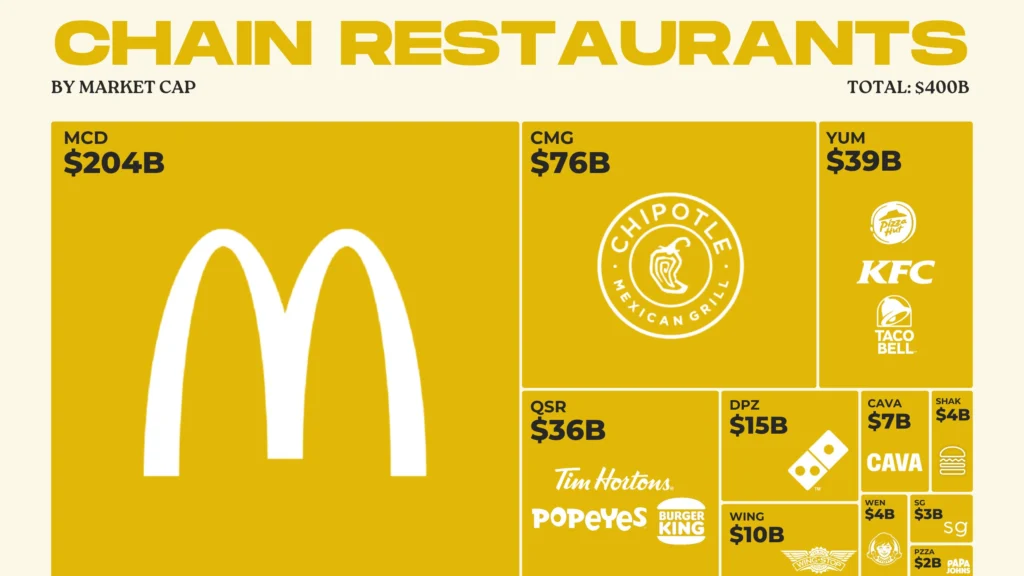
Source: Sunday Markets News
Brand Strength Meets Loyal Customer
Chipotle has created a lasting niche for itself in the US restaurant landscape, even though the company does not offer franchising. So, they own all 3,440 stores themselves.
The restaurant industry is highly competitive, and this is where Chipotle Mexican Grill's biggest advantage comes into play: its brand strength backed by loyal customers.
The fan base is so strong that fans tweet about Chipotle while waiting in line for half an hour, referring to the company by the nickname "Chipotbae," which is a combination of Chipotle and "bae" (before anyone else). A term of endearment usually given to one's partner. In addition, the chain relies on a loyalty program with more than 40 million members and just recently the Chipotle Boys have emerged, young men who apparently eat Chipotle 5-7 days a week, mainly from the finance and fitness industries.
Chipotle has always placed great emphasis on the customer and their experience. But away from the restaurant experience, it is like a friend to you via social media, immediately picking up on upcoming trends like the one above to make them go further viral. Free marketing at its best (chart 2).
With this loyal core customer base, Chipotle has made a name for itself for quality, healthy, fresh food that comes at a cost and that people are willing to wait 30 minutes in line for.
But the quality must be right.
Always…
Chart 2: Chipotle Boys – and Chipotle picks it up to make it go viral
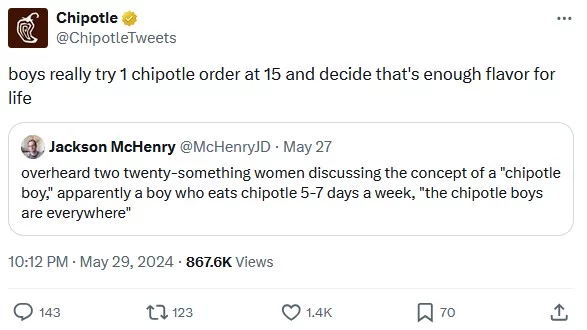
Source: Twitter
Reputation, Reputation, Reputation
Chipotle Mexican Grill was on a remarkable growth trajectory at the start of the new century.
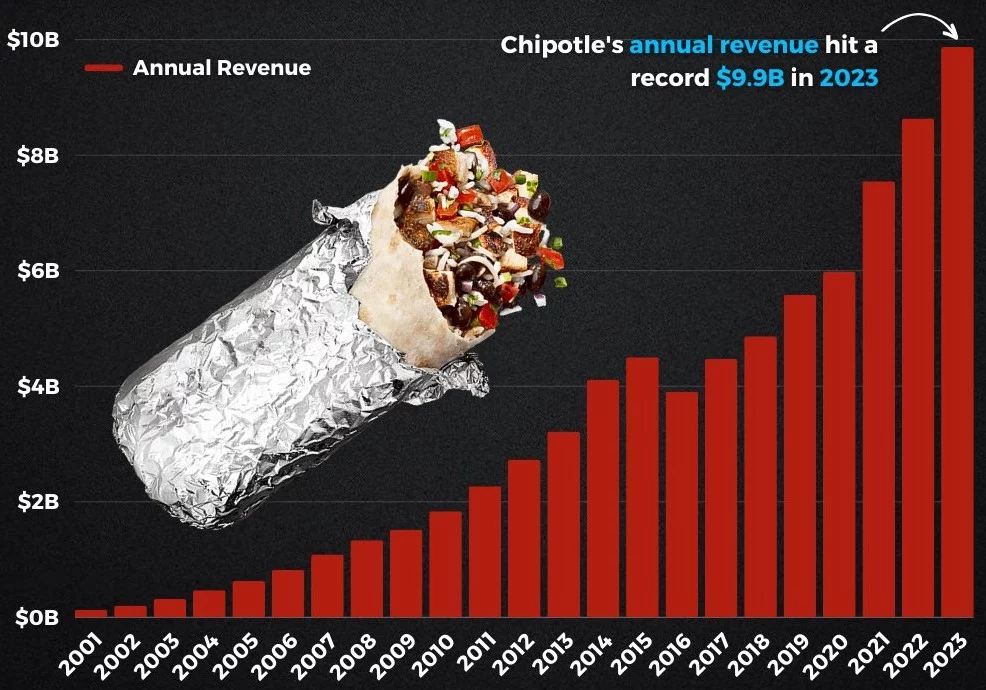
But things hit a major damper when the burrito chain ran full steam into a food safety issue. Outbreaks of E. coli and norovirus (diarrheal illness), which led to tens of hospitalizations but fortunately no fatalities, occurred in several restaurants between 2015 and 2018. Dozens had to be closed.
A reputation for high-quality food built up over decades was destroyed in the blink of an eye. However, as loyal customers are its most valuable asset, Chipotle made a point of rebuilding its reputation with huge marketing campaigns and free or discounted food.
It worked.
Impressively, after three years of struggle, Chipotle has come back stronger than ever. The company has managed to rebuild its reputation while tapping into the zeitgeist. It has built an attractive following among affluent, experience-oriented millennials and Gen Z, who spend significantly more money on dining out than older cohorts.
Today, this is reflected in significantly higher sales per restaurant than the competition.
It rebuilt its brand, its "Good Story".
Chart 3: Chipotle’s Burrito Boom, annual revenue with food safety scares in 2015-18
Source: Carbonfinance
50-1 Stock Split
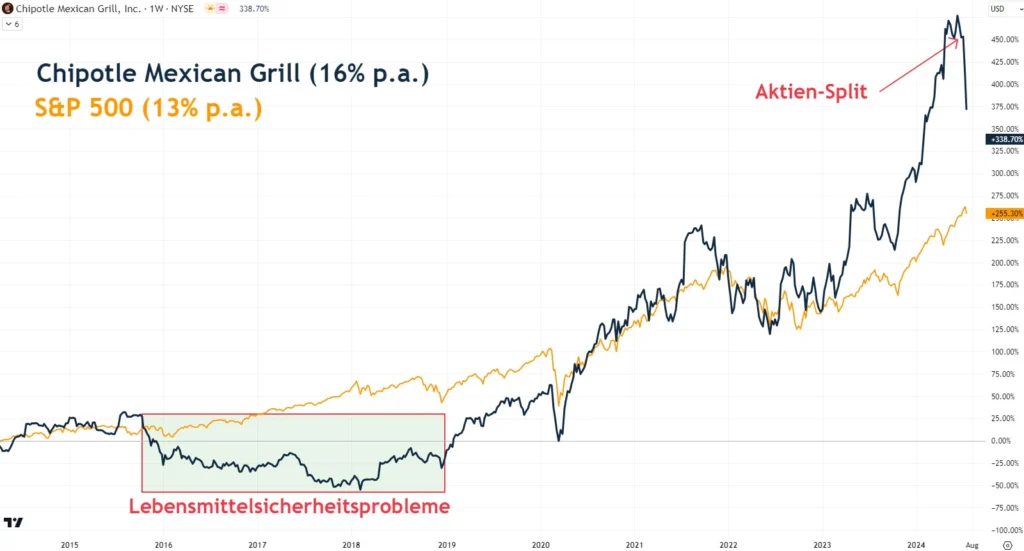
In June 2024, Chipotle shares split 50-1.
What does this mean?
A stock split increases the number of shares to boost liquidity. For Chipotle, this was the first split since its 2006 IPO. This means for every one share at $3,300, investors now have 50 shares at $66 each (3,300 / 50). Importantly, the company’s value and fundamentals remain unchanged; only the share count increases.
Why do they do this?
When a share price rises significantly, companies lower it to make shares more affordable. Although fractional shares are now available (e.g. you can buy 0.333 Chipotle shares for $1,100 before the split), a lower share price can have a psychological appeal. The ideal share price range is $50 to $200. If a share falls below $5, it is considered a penny stock, which does not have the best association. Then you would do a reverse split. The opposite.
Usually, the first split is a good sign. We would raise our eyebrows at a second or third stock split.
Because this often happens when a stock has had a stellar rise.
And the best time is then usually over.
Chart 4: Chipotle Mexican Grill over ten years
Source: TradingView