Taiwan (Semiconductor)

January 19, 2024
4 min read

"The rivalry between the US and China may well be determined by computing power"
– Chris Miller, author of Chip War
arvy's Teaser: Taiwan, a tiny island, has immense global influence as the epicenter of chip production by TSMC, the leading semiconductor foundry. As geopolitical tensions escalate, the clash between state-of-the-art technology and international politics intensifies. In the race for global dominance, the battle for control of this island and industry will determine our future.
Taiwan.
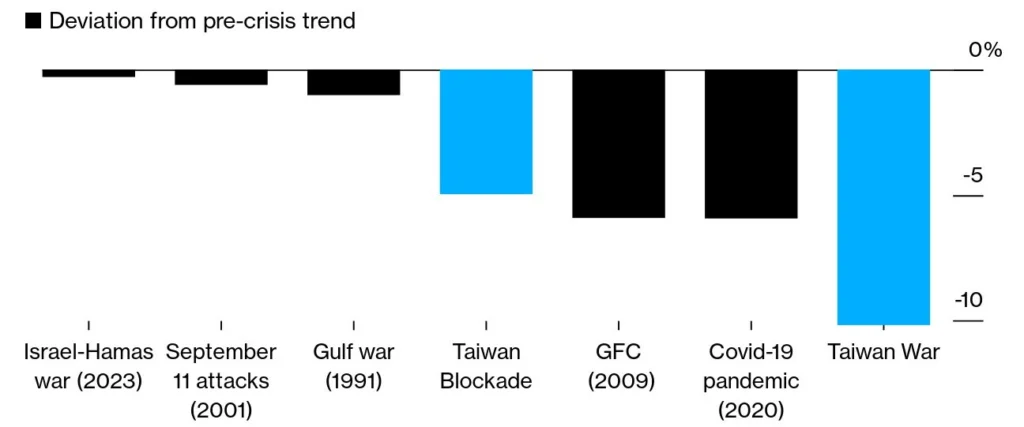
This island will be the most important discussion point on many agendas in the coming years. Be it in politics, in the headlines you read, and even in both your personal and professional life, i.e. through the products you use daily. It will affect everything (chart 1).
Why?
Because of computer chips. Chips are like the oil of the 21st century. All forms of power in the modern world, whether military, economic or geopolitical, are based on chips. And Taiwan produces 37% of the world's chips.
The battle for control of this island and this sector, which literally centers around one company, will determine our future.
The earth will revolve around Taiwan Semiconductor Manufacturing Co.
In short, TSMC.
Chart 1: The Global Risk of a Taiwan War, estimated impact on global GDP
Source: Bloomberg
Geopolitics meets cutting-edge technology
Let us first put Taiwan and TSMC in perspective. The intersection of geopolitics and cutting-edge technology is particularly evident in their example.
Geopolitics: At the heart of the Taiwan issue is China's claim to sovereignty over the island, which is countered by Taiwan's assertion of independence. This leads to complex diplomatic relations around the world, with countries recognizing China but maintaining unofficial relations with Taiwan given the nuanced historical and geopolitical dynamics. Last weekend, Taiwan's voters elected William Lai Ching-te as the new president, confirming Taiwan's pro-independence stance. This is not in the interests of China, which is even threatening to take over Taiwan militarily, and will remain a major point of contention. Obviously.
Technology: TSMC is the largest pure-play chip foundry in the world with a market share of almost 60%. In the complicated landscape of chip production, certain areas are dominated by a few market leaders, and one of these crucial processes is carried out by this Taiwanese company. More on this in the next part.
What is the problem?
China contends that, given its claim over Taiwan, it also holds influence over a pivotal aspect of global technology. The US, the world power worrying losing its dominance, treads delicately as it is heavily reliant on TSMC, seeking to navigate the situation in its favor.
It is like something out of a thriller. The most important technology for the world, and especially for the USA, comes from an island that China claims as its own.
You could not make this up, could you?
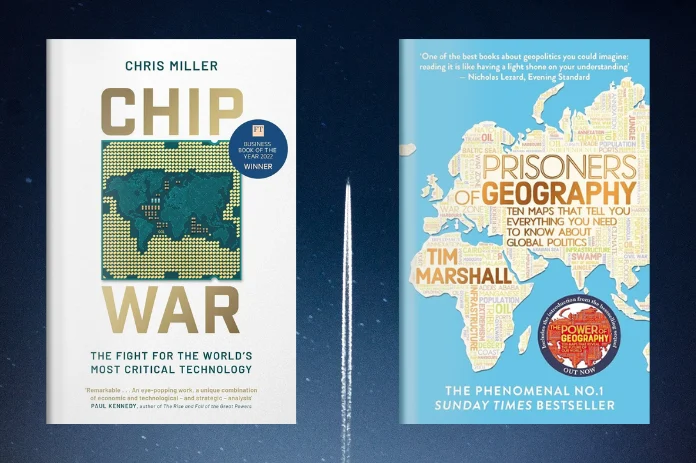
This convergence of geopolitical and technological forces is so significant that the Financial Times recognized our summer read "Chip War" by Chris Miller as the "business book of 2022". In addition, once our Christmas present, "Prisoners of Geography" deals with Russia/Ukraine, as well as China, Taiwan and the USA. As topical as ever.
Both books are must-reads (chart 2)!
Chart 2: arvy’s book club: Chip War & Prisoners of Geography
Source: arvy book club
Foundry Market Leader
Let’s focus on TSMC. In highly complex and specialized fields, the situation is always the same. There are market leaders.
The semiconductor world is a vast, complex, and fiercely competitive landscape. To survive, you must be an ant – specialized in one part of the whole process. It is impossible to be in the top league in every part of the value chain.
This is where TSMC comes in as the market leader in foundries. A foundry is a microelectronic manufacturing company that produces chips for other semiconductor companies.
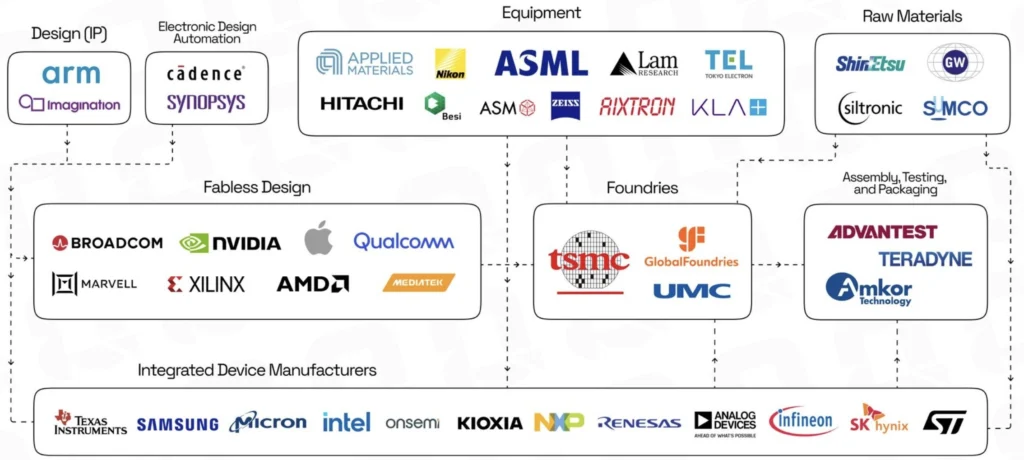
Simply put, designing a chip, manufacturing a chip, testing a chip or building the machine that makes a chip are all such complicated, difficult tasks and require so much specialization that it is not possible to do it all in one company. This means that each company only takes on a specialized part of the entire process (chart 3).
For example, Cadence develops the software to design the chips, Nvidia designs the chips, ASML builds the machine that manufactures the chips, and TSMC then manufactures the chips.
Of course, this is a very simplified way of putting it.
But this is how the world of chips works.
Chart 3: The Semiconductor Value Chain
Source: Quartr App
Two long-term growth factors
Apple, Amazon, Google and NVIDIA source over 90% of their chips from Taiwanese manufacturers. You can imagine why the US is scratching its head over Taiwan and TSMC. Their dependence on this island is considerable. This is why they even introduced the CHIP Act - a multi-billion-dollar plan to bring chip manufacturing back to the US.
Why do they not turn to someone else?
So far, they cannot. First, TSMC has a quasi-monopoly due to consolidation in the industry and the most advanced technology. In addition, its production facilities are still very much focused on Taiwan and their intellectual property. Therefore, customers will continue to have their chips produced by TSMC for many years to come.
Secondly, a new race for world power and technological supremacy is now upon the world, and no one wants to be left behind. This trend could last for decades, and TSMC will play a central role in this, as it is the best partner in the process.
It is all about who is ahead in the most discussed topic on the planet.
Artificial intelligence.
Chart 4: TSMC over 10 years

Source: TradingView